Most of my clients have been to a good number of weddings, both religious and secular, by the time that they marry.  However, they generally can’t remember much about the ceremony.  Sometimes a bride and groom can point to ceremony components they found off-but there isn’t much recollection beyond that.   Likewise, while there is a vague sense of the flow of the ceremony, couples can’t remember much about the particular parts—all of this creates anxiety. So I have prepared a little cheat sheet that describes the basic outline of the ceremony.  There are certain parts (the vows and ring vows, for example) that tend to be fixed, but rituals and readings can certainly be shifted about.  Just remember, working with a wedding officiant, like me, you will have many opportunities to customize and add to this ceremony to make a perfect ceremony for you!

Processional. The most common format is the bride walking down the aisle with her father.  Sometimes she is escorted by both her father and mother.  From time-to-time, the bride processes on her own (or possibly with another male or female relative).   Based on the bride’s preferences, the question is asked, “Who gives this woman in marriage,” to which the answer is, “Her mother and I do.” There are several ways that the groom may process.  Often the groom and his groomsmen will come to the altar area from a side entrance or side aisle.  Alternatively, the groom may wait at the front, while the groomsmen escort the bridesmaids down the aisle.  He may also enter with his parents, processing down the aisle. 

Welcome:  This is basically where I welcome everyone and begin to set the stage and mood for the ceremony.  This will be the place where you can thank particular guests—parents, siblings and what not. Some couples also choose to mention people who could not make the trip and/or people who have passed away.   (Couples may pause here and perform some ritual to commemorate deceased loved ones, such as a candle lighting.) 

Your Story.  This will be drawn from the survey that you are fill out.  Couples vary in terms of how much (or how little) of this they want to include in the ceremony.  I find that the mix of funny and light (the first date, for instance) with the more serious parts of the ceremony (your words of love and appreciation to each other) creates a great deal of intimacy among the guests.  The narrative is usually four or five paragraphs (that isn’t as long as it sounds!)

About Marriage:  This is the time that we start moving into the heart of the ceremony, the exchange of vows.  I normally include a few specific remarks about the intention of marriage (no worries, this isn’t long or “preachy”!)  A reading is very good here as well.  In the draft that I will send, I will include a popular reading, to maintain the flow of the ceremony script.  If you have a favorite reading, poet, topic, period, you can let me know.

Declaration of Intent:  There are three sets of vows during a standard, relatively formal ceremony.  The first little set is called the “Declaration of Intent.”  This is usually about four lines long where I am asking–is this what you really want to do . It is something like, “Do you, Bride, choose Groom to be your beloved Husband, etc.etc.”  You answer with a simple “I Do.” 

Reading/Ritual:  You can go straight from the declaration of intent into the longer vows. However, if you wish to have any ritual, reading, etc. this is a superb place to do so–so that you can continue the crescendo to the vows.  We can discuss ritual ideas that might be appealing to you and so on. 

Vows: This is it!  The vows can be ones that you write or others you have selected.  Usually when couples write their own vows, they speak them directly to each other.  Most couples I work with don’t write their own vows but use ones that are already written in a “call and response” format, where I say a line and you repeat it:  “I, Bride, take you, Groom, to be my wedded husband”  (repeat) etc. etc.  The other alternative is that I read the entire vow and then you say “I do” at the end.   

Ring Vows:  I usually include a transition to the ring vows, discussing their symbolism followed by the ring vows.  These are short, 4-5 lines that are usually done in the call and response style, “(Name), I give you this ring…..that it may always remind you….etc.”

Vow of Community Support:  This is something that I like to include but isn’t necessary.  This is where you ask the guests to pledge support for the new marriage.  I read a paragraph (You are the most important people to this couple, will you do all that you can. etc. etc.)  They respond with “WeDo.”

Remembrance of the Day:  I like to include a little paragraph about the significance of the day and encourage you to rededicate yourselves to these vows each year on your anniversary.

The Charge or Closing “Blessing.”  This is where we say a few words of well wishing and send you on your way.  It can have religious attachment or not.  Mine usually goes something like “May the sun of many days and years shine upon you, may the love you have for one another…..”

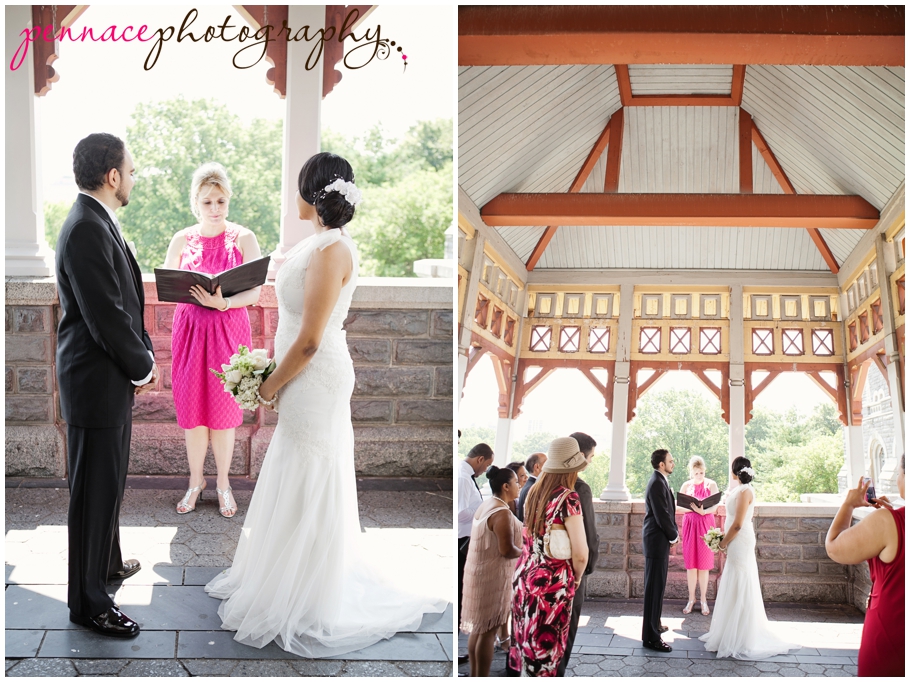
Declaration of Marriage:    This is the bit where I say, “by the authority vested in me….” and Declare husband and wife.  And then invite you to seal the promises with a kiss!

Presentation of the Couple:   If you wish I can introduce you as Mr. and Mrs. ….. if you are not having the same surname, I say something like “introduce you to the newly married family and then give your names” or you needn’t have any particular introduction at all.

Recessional:  The End!  Cheers! Reception!

Share, or leave a comment...

Among students of the women’s suffrage movement, the name Lucy Stone is a familiar one. Born in 1818, she was the first woman from Massachusetts to earn a college degree, graduating from Oberlin College in Ohio. Stone’s long list of accomplishments includes initiating the National Women’s Rights Convention and delivering the speech that led to Susan B. Anthony to enlist in the suffrage movement. As perhaps an historical asterisk, Lucy Stone is the first recorded woman to have continued to use her “maiden name” after marriage. It would be a century and a half, before that debate would really take off, but as I became deeply connected to wedding celebrancy work, I wondered about the preferences of today’s brides relating to the last name they would use following marriage.

One of the highlight’s of any wedding ceremony is the “presentation of the bride and groom.” This is the moment, following the declaration of marriage and the kiss, when the officiant introduces the newly married couple, which of course is usually met with cheers and great applause. I preparing ceremony scripts, I always ask brides and groom if they wished to include this in the ceremony and what names would they be using after marriage. I was a bit surprised to find that the vast majority of my brides were eager to take the surname of their new husbands and delighted at the prospect of being introduced as “Mr. and Mrs.” For those individuals who kept their own name, I offered slightly reworded introductions such as, “I am pleased to be the first to introduce the newly married family of Michael Jones and Mary Smith,” or “For the first time as a married couple, may I introduce Jennifer and David.”

Were my couples representative of contemporary brides and grooms? As I am big fan of statistics and trying to understand the “big picture,” I asked a young associate to track down authoritative figures on this question. According to Brides Magazine (not the Census Bureau, but a reasonably authoritative source), one-quarter of brides don’t change their names. Of the three-quarters who take their husbands name, about a third will use their original surname as a middle name or decide, with some percentage hyphenating the two. And while the City Clerk’s office doesn’t keep official statistics on such matters, they concur that about a quarter of the applicants indicate on their marriage license application that they will not take a new surname.

Regardless of the selection of post-matrimony names, a hearty Mazel Tov is in order for all!

I appreciate the assistance of Niafel Santos in gathering this information. Niafel is a rising junior at the Fashion Institute of Technology.

Share, or leave a comment...


In speaking with couples about their wedding planning, I often remind them that small decorative and ceremony details offer a real opportunity to subtly—but powerfully—personalize the event.  While some brides and grooms seem to embrace the perspective that spending a lot of money on every component of the occasion is the surest way to “produce” a wedding all their own, I actually think it is in the very small choices can come together to make a ceremony truly outstanding.  The creativity is generated not through selecting costly alternatives, but grows out of a mindful perspective in planning the wedding and a capacity to “think outside the box.”  I was reminded of the gifts of careful planning at a wedding a few days ago.

Sandra and George are a beautiful couple, one reflecting the adage that love is better the second time around.  It was clear from our first meeting that Sandra was not only super-organized, but she is a skilled decorator, too.  The two shared many happy memories on the beach in their native New Jersey, as well as destinations they’d visited during their courtship.  So it was natural that they situated the wedding and reception at a beach venue in Long Branch, New Jersey.  Le Club is literally on the beach, and the sunset ceremony was on their roof terrace.  Sandra had fashioned a festive environment with hurricane lamps and tapestry throws where guests were seated for the ceremony.  While she made lovely choices with all of the wedding “accessories” (flowers, the runner and such), one detail jumped out because of its beautiful, sentimental nature.  She included a handful of seashells that she and George had collected in her bridal bouquet.  The shells were positioned on a bed of white flowers so as to add just a touch of color and texture—perhaps not even noticeable to some.  The florist did a terrific job designing a sophisticated bouquet for an elegant bride.  I found it such a touching reminder of their romance, that I was prompted to add a short reading, to the script, from Anne Morrow Lindbergh’s Gift from the Sea.

The sea does not reward those who are too anxious, too greedy, or too impatient. To dig for treasures shows not only impatience and greed, but lack of faith. Patience, patience, patience, is what the sea teaches. Patience and faith. One should lie empty, open, choiceless as a beach — waiting for a gift from the sea

Share, or leave a comment...

Last night I had the honor of marrying the stunning Tina and Greg.  Much about the wedding was “Quintessential New York.”  The rooftop ceremony was held at the “Fashion Hotel” in the garment district.  The stunning sunset views honored the couple’s love of our great City and our bride’s passion for the world of fashion, as she is a professional stylist.  Many guests were from that industry and were a feast for the eyes.  (I came to realize that these people were as beautiful on the inside as they were on the outside.)

The bride is from a wonderfully traditional Filipino family, and in honor of her Heritage, Tina incorporated the tradition of a veil and cording ceremony.  This custom is quite beautiful and is a sweet opportunity to include special guests in the ritual.  The cord and veiling are situated in the ceremony before the vow and ring exchanges.  In our slightly modified version the mothers of the bride and groom served as the veil “sponsors.”  As such they were called before the guests to gently place a beautiful tulle veil gently on the shoulders of the bride and groom.  The description of the veil calls to mind the union of the couple and the protection of love they experience from their beloved community.  Two very special friends, including one who introduced the bride and groom, were appointed the cord sponsors.  They placed a specially created cord around the necks of the couple.  The cord is designed in a “figure 8,” the recognizable infinity sign.  The cord signifies the strength of the couple’s love and the literal “tying of the knot.”  Like the round ring exchanged later in the ceremony, the infinity sign of the rope shows the unending nature of the love.  The cord and veil are removed before the more standard vows, but I am certain that it is a highlight of the ceremony for guests who are not familiar with the custom.  And of course is a moving tribute to her family of origin which nurtured a childhood with many memories from their ancestral homeland.

I look forward to seeing photos of the ritual from the wedding, but a shot from the rehearsal earlier in the day gives a hint of the visual feast offered to those in attendance.

Share, or leave a comment...

On Saturday I officiated a small wedding for a fun-loving Brooklyn couple.  The celebration was at the Boathouse at Prospect Park.  Although Prospect Park was designed by Frederick Law Olmstead, it is less familiar to most of us compared to his more famous Central Park.  But it was a stunning spot.  The day was clear as a bell and about 30 friends, family members, and former students attended the event.  The bride and groom have a wonderful love story.  They met nearly two decades ago and dated for several years.  Not ready for a serious relationship, they followed separate paths for many years.  And then, through the wonders of Facebook, they reconnected several years ago.  Surely it was “meant to be.”  They are mindful of their prized possession, a relationship that was nearly lost.

The couple let their personal style shine through in all aspects of the ceremony, including casting their beloved dog Kona as the “ring dog.”  Kona sported a specially designed collar that included a pouch for the rings.  At just the right moment, the two young nieces of the bride untied the little pocket and passed the grooms to the bride and groom—to the cheers of the wedding guests.  In a place like New York, where many do not have children, dogs really are man’s (and woman’s) best friend.  So I say bravo for to the off-beat bride and groom—and Kona of course!

Share, or leave a comment...